I know you know the purpose of this project, but for the sake of any other readers, I’ll reiterate: we are two friends who share some common interests (books, food, writing, visual art, biking) and many uncommon ones. Since you’ve recently moved away, and neither of us is particularly good at keeping in touch, we decided to come up with a shared project–both to help us stay in contact, and to keep us both writing. So each week, we will write each other a letter, on our respective blogs (https://inalluncertainterms.com and https://lettersfrompangea.com). Hopefully, the routine will inspire more writing.
There is a sentence commonly spoken between me and my husband: “The mind of another is truly unknowable.” It comes from this tweet I saw one time, that has stuck in my brain like an ear worm.
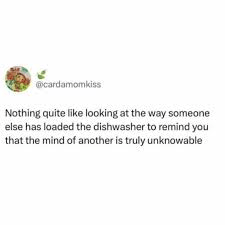
I say it when watching him load the dishwasher, but it also comes up other times. We were recently discussing Jane Austen, and he expressed his perspective that, while her writing is objectively good, he can’t help but find her books boring.
“Nothing happens except people sitting around and talking all day, and visiting each others’ houses. None of it matters, in the grand scheme of things.”
My husband’s usual reads are sprawling, epic fantasies that fill thousands of pages, and in which the stakes are extremely high–usually, the fate of the whole world. I also love such books, but Austen’s work is near and dear to my heart, so I felt called to defense.
“It does matter,” I protested. “For most people, the ordinary events of their lives matter to them. Interpersonal relationships are of the utmost importance to lots of people, and the stories Austen tells of insecurity, shame, resentment, forgiveness, and reconciliation are relatable and touching.”
“Yeah, sure, but I just feel like the stories are all about people who have way too much time on their hands. They’re rich and have nothing to do but to think and talk about other people whom they barely know, and fixate on an insult from someone they met one time.”
“Maybe those characters weren’t busy, but you can be working and still have time to think about the relationships in your life. When I’m washing dishes or folding laundry, I’m not only thinking about the thing I’m doing.”
I then shared an example of someone I only met once, whose opinion of me I think about fairly often. The night of our wedding, before going on our honeymoon trip, my husband and I stayed at an AirBnB. I misremembered the checkout time, and we ended up leaving our car there later than we were supposed to. The host was not very gracious. I apologized many times, offered to pay more for the inconvenience, but she insisted she didn’t want money: only for me to undo the past, so we’d never have left the car there in the first place, and to make it instantaneously be gone–despite the fact that we were already on the train, and I was at the mercy of my family members who were on their way to pick the car up.
I spent a fair portion of our six hour train ride crying. As a chronic people-pleaser, I was unable to shrug off the host’s anger with me. No amount of sincere apology, nor efforts to compensate her for my mistake, would appease her. Though it’s been four years, and though she in no way affects my life now, something in my brain desperately wants everyone always to love me, and it fixates on that failure (among others). I shouldn’t think about her, but I do, more often than I’d like to admit. So I find it easy to relate to the Bennets’ obsession with Mr. Darcy’s slights and social faux pas, especially since the events had occurred much more recently in their histories than the memories of my own ruminations.
My husband listened with disbelief, and told me he hasn’t thought about that AirBnB host since that day years ago. I shrugged.
“The mind of another is truly unknowable.”
As we’ve participated in the group chat your father made, in which each week the members listen to a different musical album, this sentence has come to mind often. Sometimes, even when someone has a different opinion than I do about a particular artist or album, I can at least understand and appreciate their perspective. Other times, I find their view completely baffling. The mind of another is truly unknowable.
A few days before you left, we went on a bike ride with many of our friends, then met at your parents’ house for dinner afterward. Your former-coworker-turned-friend, whom I’ll call Hayden, gave you a CD onto which he’d burned a dozen songs from various artists. I found it to be a surprisingly thoughtful and sweet combination birthday and moving away gift. Admittedly, I don’t know Hayden all that well, so perhaps it’s typical of him. Nevertheless, I was touched on your behalf.
“Hayden made me a mix tape,” you told your mother later in the evening. She looked it over and read aloud a few of the artists.
Amused, she remarked, “It looks like Hayden made Hayden a mix tape.”
I wondered if I was wrong to have thought his gesture extraordinarily nice. My second-guessing was short lived, though. In the weeks since your departure, due in no small part to this music group chat we share, I have thought a lot about that mix tape. Sure, it was filled with songs Hayden likes, not necessarily styles you would be likely to enjoy, but I find sharing music with another to be an exceptionally intimate act, yet one in which almost anyone can participate.
Because of my aforementioned people-pleasing tendencies, combined with how the music I love feels like a part of me, not just some external media with which to interact, I find the prospect of sharing my Spotify activity with others nothing short of mortifying. I have my profile settings on private for that reason, and when directly asked to what I like to listen, I find it intimidating to give an answer. I recognize many people don’t feel so strongly about sharing music, but I think a person’s preferences reveal something about who they are, even if they are more loosely attached to them.
I’ve heard it argued that defining your identity by art you like is immature and unstable. Art will never be universally loved, so your identity will always feel under attack. While I think this is true, and it’s important for every person to know who they are apart from the media they consume, I also think that without qualifiers, this argument is overly simplistic. Does the music to which I listen define who I am? No, of course not. Though it may seem like it online, the world is not predominantly divided into Swifties and non-Swifties. However, I do think the musical culture of my Spotify playlists reflect aspects of my real life. Two of my favorite albums I’ve ever heard, whose every note I now know by heart, were recommended to me by my husband, so the closest relationship in my life is represented by some of the most-listened-to music in my repertoire. Also in my library are several Christian artists who are not widely known, even among the general Christian community, but who are wildly popular among my small church. The most important web of relationships in my life is thus represented, too. Moreover, music can express thoughts and emotions that are otherwise difficult to get out. One particular artist was a great solace to me in my teenage years, and when my mind was full and heavy, her songs always seemed to come at the right time, putting words to the things I couldn’t. I don’t relate to the lyrics of her songs as much as I once did, but I still remember what it felt like years ago, and in this way my own history is represented. I could go on, but I think you get the drift.
Because of this, I think it’s only natural to feel defensive when someone criticizes art you love. An album from this project which was, for me, a 5/5 rating, and which brought me to tears upon first listen (a somewhat rare occurrence), was described by a fellow member as “so boring they couldn’t finish” and given a 0/5. The perhaps immature part of me that felt the need to right this obvious wrong wanted to shoot back that they sounded like a Cocomelon iPad kid grown up and continuing to rot their brain away on TikTok to the point their attention span is so shot that they can’t bear to listen to anything that’s not all loud and fast and insubstantial. I reminded myself, though, that even if this person really was attacking my identity, that’s okay, too–and that I should treat it as an opportunity not to assume their incorrectness, but to learn about who they are, and what it says about them that this particular album did not connect.
The mind of another is truly unknowable, but you can catch glimpses.
I came to the conclusion that, regardless of whether Hayden made your mix tape with what he enjoys in mind, or what you enjoy in mind, it is still a very good parting present. I first discovered one of my favorite songs in the world through a playlist a friend made for my birthday, and I still think of her with gratitude when I hear it. Even if you didn’t end up loving any of the songs on your mix tape, for a portion of your journey to your new home, you were able peer into the inner world of your friend, and I think that privilege is as nice a gift as any.
 In All Uncertain Terms
Leave a comment