I am all but convinced that no fruitful conversations between two disagreeing parties occur in the town square of the internet. Because of this, I do my best to never ever engage in political discussions online. For a variety of reasons, including the misinterpretation of tone, lack of body language, and the convenient lack of a human being into whose eyes you have to look while you say the insulting or belittling or dismissive thing, they seem to quickly and easily devolve into snowball fights of hurled blame and accusations and straw-man arguments. I’ve also become generous with the “unfollow” button, using it any time someone I know posts something that raises my blood pressure. I don’t want the temptation to engage, but I also don’t want my anger at what someone posts online to mean that I can’t respect them enough to have a real life conversation with them. If face-to-face is the only way change can happen, I need to preserve that potential if at all possible–which means not allowing myself to start thinking of that person as a lost cause with the worst opinions, no intelligence, and lacking a conscience. So I’d rather live in blissful ignorance of the bad takes they type into their phone, that way I can be unpleasantly surprised to know what they think, and address it head-on.
However, I had a lingering small hope that even if we can’t talk about big issues in a productive manner online, maybe we can talk about the way information and communication happens. I attended a Classical Christian high school, and while I missed the bulk of the logic portion of a Classical education, I believe the greatest thing I learned was how to think and communicate well. I entered the school in the last stage, rhetoric, it builds upon the logic taught before, so I still learned more formal logic than I would, had I gone to high school elsewhere. It is because of this teaching that I now, six years after graduation, no longer forced to identify logical fallacies, still find myself analyzing the rhetorical tools of various online communications. My sparse, feeble attempts to address the underlying workings of these persuasive statements have been met with crickets–and I’ll admit, it’s not as glamorous as posting one’s unpopular opinion, nor as rage-inducing.
I lamented the lack of engagement with my comments for a while, but as it’s become increasingly difficult to find the time and energy to write other pieces here, I had a thought: why not turn my frustration into content? It’s something I’m thinking about anyway, so it’s no extra or forced mental effort, and it gives me an outlet to express my concerns with how we choose to interact with information. Besides, in the dumpster fire that is Facebook, there is no shortage of low-hanging fruit to address. This will be a series in which, as I find articles or infographics or whatnot that are meant to persuade, but do so badly, I will dissect them. It’s a bit lazy, but it’s something.
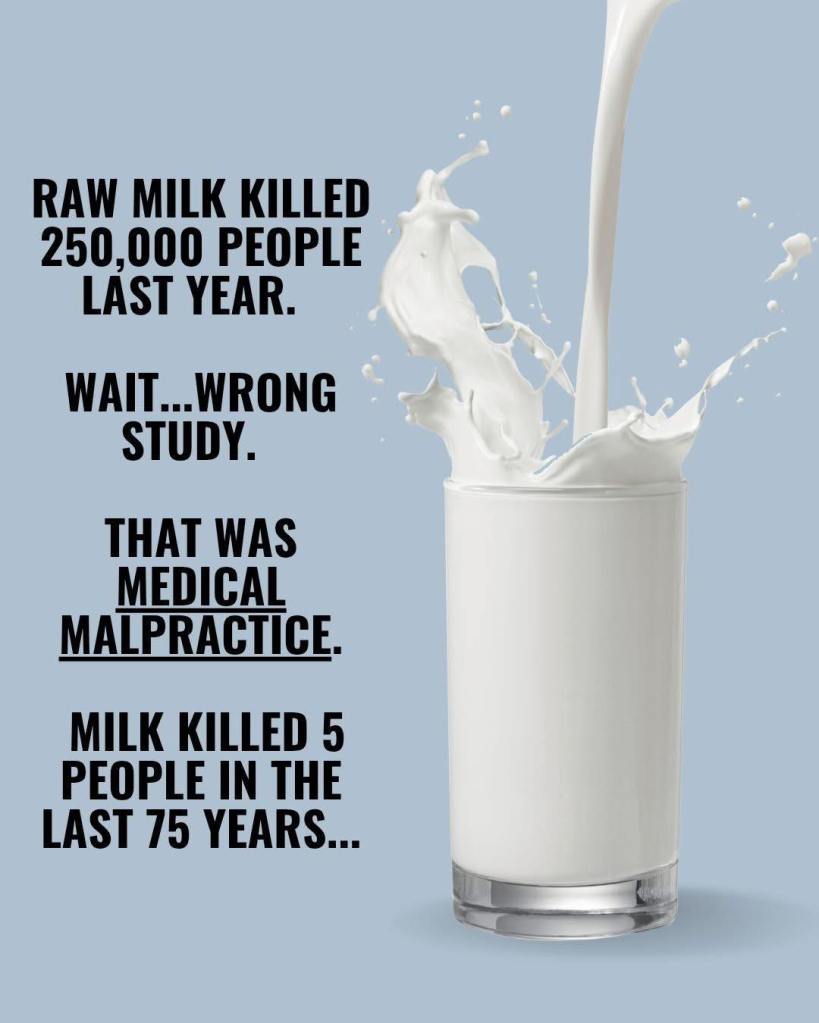
This was shared by someone I know. I generally consider this person to be reasonable and intelligent, but we all fall prey to faulty but effective rhetoric sometimes. I’m not entirely sure what the specific message they hope for the reader to take away is, but I’m guessing it’s something like this: raw milk is natural, and its dangers have been incredibly overblown. The medical system is very dangerous, and you should be distrustful of doctors and other practitioners. There are several things about this that I find troubling.
First, there are no sources. For all I know, the creator of this image could have completely made these figures up. Even in the article linked in the comment section (which I’ll also link at the end of this page), there were no sources. There is a vague reference to “CDC data” that neither names nor links to any page or study, as well as an appeal to “alternative historians and whistleblowers,” who also remain entirely unnamed. If you want to actually read the data that lead the author to these statements, good luck finding it!
Second, all good logic and good communication begins with defining your terms. What are the parameters set forth to determine what a death from raw milk is? Death from medical malpractice? If an individual drinks raw milk and becomes infected with tuberculosis, then dies from tuberculosis, does the author consider it a death from drinking raw milk, or a death from tuberculosis? It may seem like a silly question, but it drastically affects what numbers result from your study. There is no guidance in either the image or the article about how the cause of these deaths was determined, the demographic for this data (Americans, or the whole world? 250,000 is .07% of Americans, but .0003% of the world; that’s a huge difference), or how the data was collected.
Third, we’re not comparing apples to apples. Death from drinking raw milk is an incredibly specific scenario, while death from medical malpractice is very broad. It’s like comparing the number of people who have died in car accidents to the number of people who have died from Rottweiler attacks. Many, many more people ride in cars, much more frequently, than those who encounter dogs, more specifically Rottweilers, frequently. I would guess that many, many more people regularly use the medical system than regularly drink raw milk. There is a huge difference in scale. A more helpful metric would be to compare percentage of people who die from drinking raw milk, out of the total number of people who drink raw milk, versus percentage of people who die from medical malpractice, out of all people who go to the doctor. I would also argue that the denominator in these percentages should be not just people, but events. The more frequently you drink raw milk or go to the doctor, the more likely you are to die from either cause, simply by increased exposure.
Fourth, these “facts” are unrelated. The creator would like her audience to think that they are, because it supports her narrative. However, raw milk can be safe and the medical system unsafe (what I believe the author is trying to convey). Raw milk and the medical system can both be unsafe. Raw milk and the medical system can both be safe. Raw milk can be unsafe, and the medical system can be safe. Though it’s not explicitly stated, the author is using the false dilemma fallacy, unnecessarily pitting raw milk and modern medicine against each other.
Finally, while not present specifically in the image, here is what I find most concerning: when I clicked the link associated with this image, I was taken to a blog post titled “Raw Milk: The Ancient Medicine They Don’t Want You To Drink.” Ah, yes, the elusive “they” that plays the villain in all conspiracy theories. Upon reaching this article, I was immediately met with a pop-up ad for supplements. There are six (6!) other advertisements on this one page, two of which are for intermittent fasting. If I click on them, I will probably be directed to a service where I can pay the low, low price of $12/month for the magical intermittent fasting plan that will melt the fat off my body and improve my life in every conceivable way.
The author writes, “By sterilizing milk and stripping it of its living enzymes, vitamins, and beneficial bacteria, governments worldwide created a need for supplements, synthetic vitamins, and ultimately, pharmaceuticals. Coincidence? Hardly.”
To that I say, “By sowing mistrust in modern medicine and persuading you that all your ailments can be cured by vitamins, minerals, and probiotics, Anya Vien created a need for supplements which are conveniently sold by Anya Vien for $50/pound. Coincidence? Hardly.”
In a timely YouTube video (that came out as I write this post), science communicator Hank Green expresses the idea that while science is aimed at discovering the truth, pseudo-science is aimed at capturing your attention and dollars. Unfortunately, since it doesn’t need to have any grounding in reality, pseudo-science also gets to tell more compelling stories. “The institutions are out to get you, and they’re trying to hide the one key to your success and happiness!” is a much more thrilling narrative than “You have access to everything you need to be healthy; you just don’t have the self discipline to do it.” If I believe I would be healthy, if only the government hadn’t told me not to drink raw milk, I get to blame someone else for all my problems. If, however, the way to be healthy is simply to choose to eat whole foods and exercise regularly, contrary to my inclination to eat ice cream while watching TV on the couch, that’s a lot less fun, because I have to take responsibility.
This author’s other posts have similar bizarre clickbait titles including “The 8 Glasses of Water a Day Myth–You’ve Been Lied to Since 1945” and “They Said Crocs Were Comfortable–But They Never Told You This.” I’m guessing the latter argues in favor of barefoot shoes, for which the author probably provides a convenient affiliate marketing link. I’m not sure about the former, but I’m unwilling to investigate, as I don’t want to give her any additional ad revenue.
Ultimately, I’m not here to argue whether or not you should drink raw milk. My purpose in writing this is to point out the way bad information and bad communication happens online. I trust your ability to do research and decide for yourself whether or not it’s a good idea for you to drink raw milk. While I have no doubt that the folks sharing this type of information have no ill intentions, I cannot say the same for those creating it. Although Anya Vien states, “The key mission of my site is to empower people with factual facts about the toxic chemicals, heavy metals, hormone disruptors found in foods, medicine, and personal care products,” I believe she is not being forthcoming. She has something to gain–your attention and your money. Besides, I don’t trust anyone who uses a phrase like “factual facts.”
When every day on the information-saturated Internet feels like drinking from a fire hose, it’s important to be mindful of that information, and to evaluate what it’s really trying to communicate and how it’s going about it. I hope this series will help people to become more conscious, thoughtful consumers in the digital world.
~~~~~~~~~~~~~~~~~~~~~~~~~~~~~~~~~~~~~~~~~~~~~~~~~~~~~~~~~~~~~~~~
https://mediabiasfactcheck.com/anya-vien/
https://livingtraditionallystore.com/
 In All Uncertain Terms
Leave a comment